

Food pilot laboratory
The plant-based food sector is rapidly emerging in Australia, with consumers embracing plant-based foods as a part of their diet.
Enhancing the technology and research capability for plant-based foods will attract further investment in South Australia.
Our research increases the potential value-adding, food manufacturing and export opportunities for plant based-food.
The food pilot laboratory's infrastructure enables experimental and pilot trials, in liaison with industry.
Most equipment is suitable for working with a range of raw materials and ingredients, both animal and plant-based.
Ingredient and food processing equipment
- Jet mill and air classifier:
- pilot scale dry fractionation of cereals into protein and starch rich fractions
- processes up to 10 kilograms of grain per day.
- Thermo scientific extrusion systems:
- suitable for both low and high moisture extrusions, producing snacks, plant-based dry protein ingredients, and fibrated protein products
- lab scale (11 millimetres) processes volumes of 0.02 to 2.5 kilograms
- pilot scale (24 millimetres) processes volumes of 0.5 to 50 kilograms.
- Armfield ultrahigh temperature processing system:
- processes liquid and semi-liquid foods, and beverages to commercial sterility, including baby foods, condiments, milk, ice-cream, yogurt, desserts and puddings, purees, sauces and soups
- typical processing flow rates are 10 to 20 litres per hour with holding temperatures up to 150°C
- at pasteurisation, temperature flow rates of up to 60 litres per hour are achievable, with minimum processing volumes for some products.
- TERRA food-tech retort:
- benchtop autoclave designed to cook, pasteurise or sterilise packaged foods, for developing new formulas and containers
- processing parameters (temperature and pressure) can be controlled, suitable for glass jars with metallic lids, pouches and plastic containers, and cans.
- capacity is 50 litres.
- Vincent screw press:
- horizontal screw press to dewater or concentrate product streams, such as food wastes, fruit and vegetable juicing, citrus peels
- liquid is forced through a static screen by a rotating screw
- press cake moisture is controlled by a discharge cone actuated by an air cylinder
- capacity is 70 to 225 kilograms per hour for feed rate.
- Vacuum packaging machine and bag sealer
- Two-stage homogeniser
- Blast chiller and freezer
- Temperature and humidity cabinets.
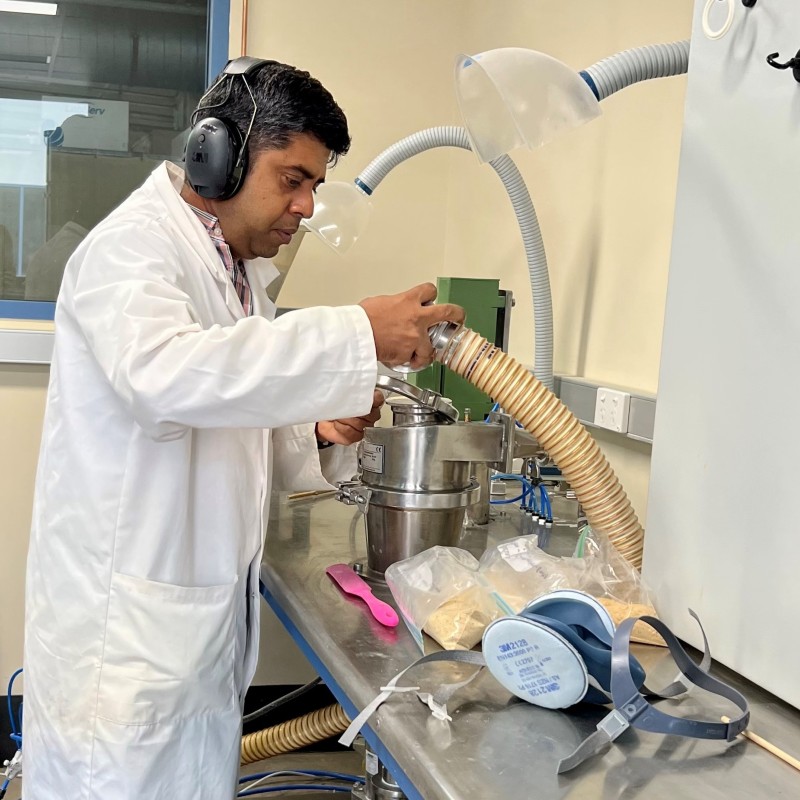
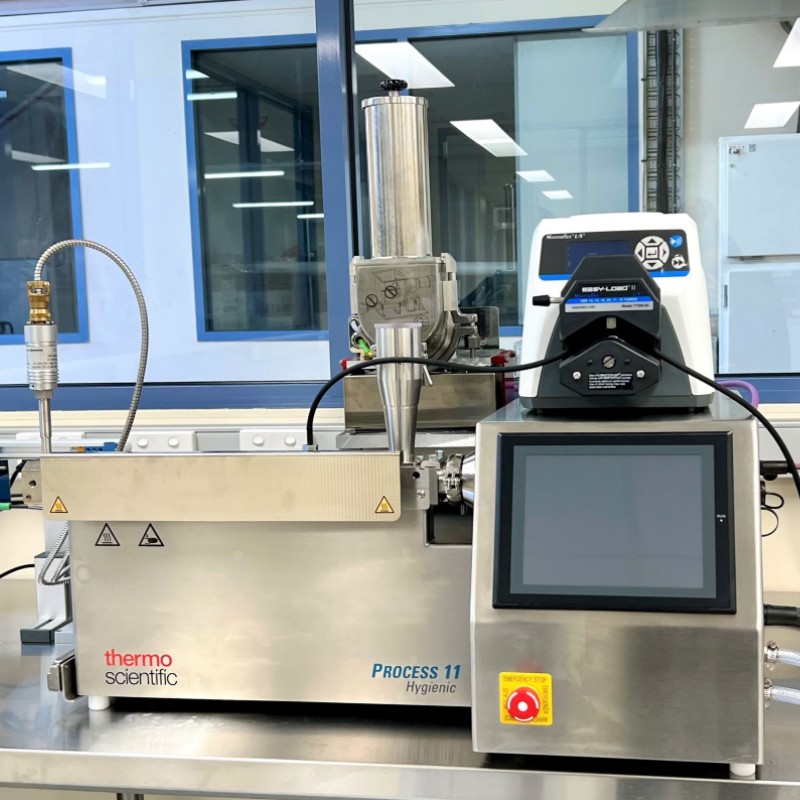
Here at SARDI we use two types of extruders in our pilot plant.
First we have the Process 11 Extruder, a venture-scale machine ideal for small scale trials, operating with as little as 200grams per hour of input material.
For larger batch trials we use the 24 MC extruder which processes around 5kg of material at a time.
Both machines follow a similar principle. We feed the extruder with a main ingredient, typically a plant protein powder, along with a lubricant, usually water. Depending on the product we are developing, we also add ingredients like oil, spices and flavours, to customise the final outcome.
Inside the machine’s spiral, twin screws move the material forward while mixing, heating and compressing it. At the end of the barrel, the product is pushed through a die, forming it into the final shape.
We control key parameters such as temperatures, screw speed and pressure using a touch screen panel.
So, what do we use extruders for?
The lab scale extruders are used for product development, material testing, and formula optimisation. They allow us to fine-tune product properties at a small scale – an important step before scaling up to commercial production.
More specifically, we use extruders to create high-moisture products like plant-based meats, that mimic the texture of real meat, or low moisture products such as packet snacks such as twisties, crispy cereals or textured vegetable proteins.
This flexibility makes extruders essential tools for developing innovative new products for the food industry. Whether you’re looking to create a puffed snack, or meat analogue, come chat to us about your vision and we are happy to assist.
At our pilot plant we have a flexible scale pilot HTST system designed for small scale product development and testing.
This system includes our homogenizer, a tubular heat exchanger unit, a chiller and an aseptic filler.
It allows us to replicate factory processes in a controlled lab setting. So here is how a UHT system works…
The system beings with a product being fed manually into a 5-litre hopper. From there the product is pumped through a re-heating section, where its temperature is gently increased after pre-heating. The product is directed through the homogenizer which improves consistency.
It then flows into the final heating section, where it is rapidly heated to high temperature and chilled from 2 seconds up to 30 seconds depending on product and processing requirements.
After reaching the target temperature, the product is cooled quickly to preserve quality and extend shelf life.
Finally, it passes through the aseptic filler where it is safely collected into pre-sterilised bottles under hygienic conditions.
The complete system is run and controlled through a user-friendly touch-screen control panel, allowing us to adjust and track all critical process parameters, such as temperature, flow rate and pressure in real time, ensuring full control and reliable data for every batch.
So, what do we use it for?
We use our pilot UHT system to develop new recipes including dairy products, plant-based drinks, and sauces. It allows you to fine-tune your product before moving into a full-scale production – saving time and reducing waste. The system requires as little as 5 litres of product as a minimum, per run, to obtain roughly 3 litres of product.
In addition to product development, the system is also used for shelf-life studies, allowing us to evaluate how long products remain fresh and stable under different storage conditions.
So, we invite you to bring your ideas and collaborate with us to test, refine and accelerate your product development in a safe, efficient and cost-effective way.
Analytical equipment
- Particle size analyser – measures the particle size of milled and fractionated flours.
- Protein analyser – accurately measures protein levels in raw materials and foods.
- Fibre analyser – insoluble, soluble and total fibre measurements in raw material and food samples.
- Texture analyser – tests food:
- firmness
- consistency, flow and body
- spreadability
- tear or burst strength
- breakage and shearing
- textural properties of bakery products, cereals, confectionery, snacks, dairy products, fruit and vegetables.
- Near infrared food analyser – routine analysis of quality parameters during food production, such as:
- moisture
- protein
- fat
- gluten.
- Viscometer:
- analyses the viscous properties of food ingredients, such as starch, grain, and flour, as they are heated and mixed in the presence of water
- temperature ramping allows test temperatures up to 140°C.
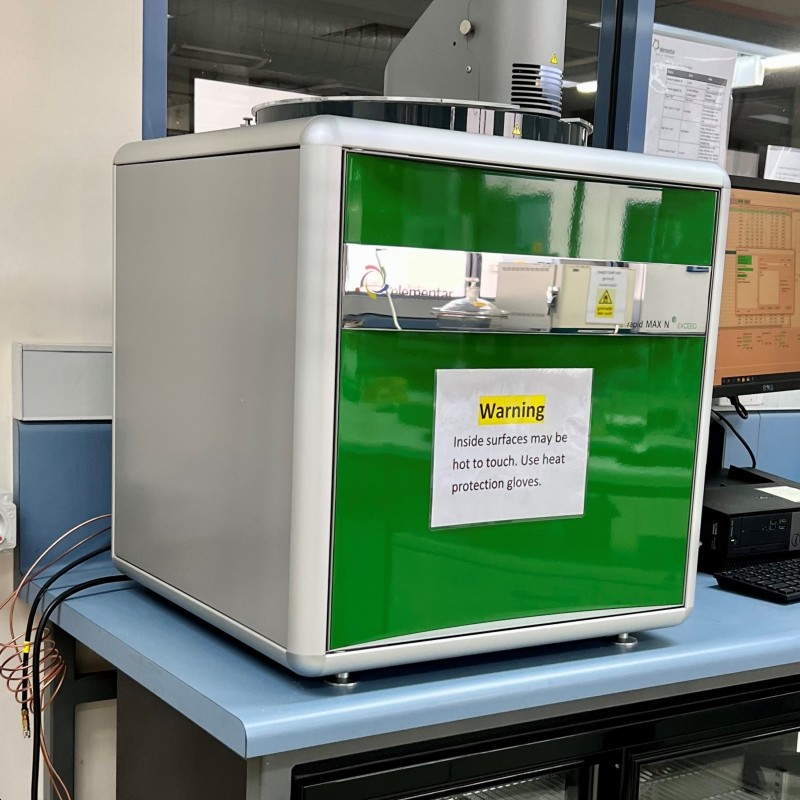
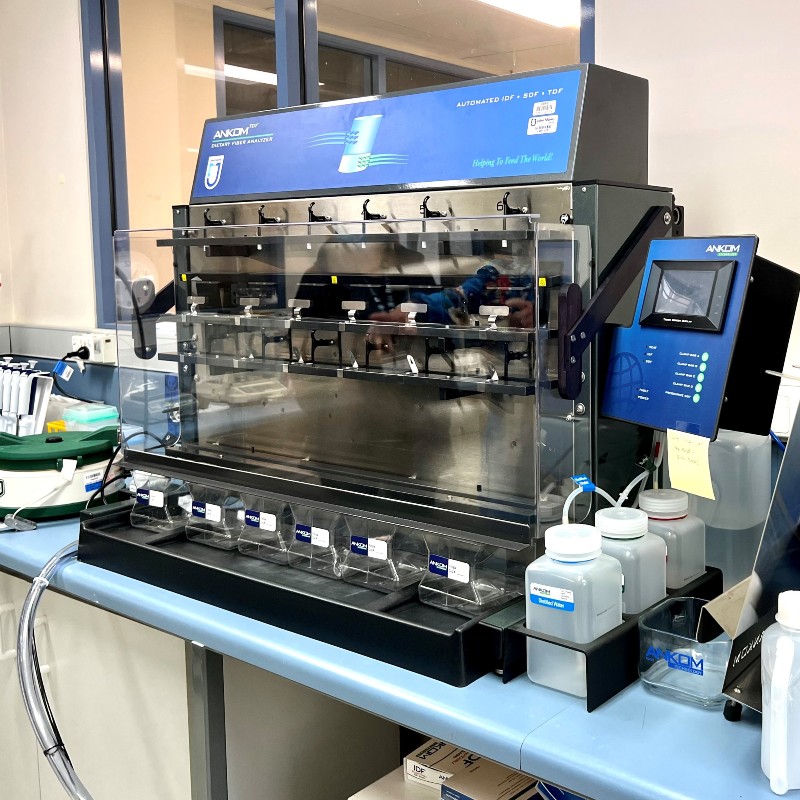
At SARDI we have a range of analytical labs that can carry out an array of analytical testing. These can be used to evaluate your products based on your desired testing.
Some examples that we will describe today are the moisture analyser, the protein analyser and the texture analyser.
The moisture analyser machine is a loss and drying method which involves weighing a sample before and after to try to determine the moisture content. The sample is placed on a weighing pan and the initial weight is recorded. A heating element like a halogen lamp or a ceramic heater is used to evaporate the moisture from the sample. The sample is continuously weighed during the heating process and the weight is monitored until it reaches a constant value.
Once the sample reaches constant weight, the final weight is recorded.
The moisture content is calculated as the difference between the initial and the final weights, often expressed as a percentage.
We use a moisture analyser for quality control, and process monitoring.
Moisture content helps in regard to shelf life, texture, and overall quality.
Protein analysers determine the amount of protein in a sample, often by measuring the nitrogen content of the sample. This machine uses Dumus method. The dumas method for protein analysis in the food industry works by combusting a sample at high temperature, converting nitrogen in the sample into nitrogen gas. This is then measured, and the result is converted into the protein content.
A texture analyser works by applying controlled forces to a sample and measuring its response. Specifically, the force, distance and time data. This data is then analysed to determine various textural properties like hardness, chewiness and adhesiveness. The instrument typically moves a probe or _____ up and down or in other directions to deform the sample, and the resistance is recorded.
A texture analyser allows us to objectively measure and quantify the physical properties of the food by mimicking real-world interactions like biting, chewing or crushing. It helps to understand a controlled texture for quality control, product development, and research and development purposes.
In our analytical lab we also have hurdle technology with pH metre, water activity and bricks, which help to gauge the shelf life of a product.
For a full list of all our equipment, please get in touch.
We look forward to collaborating with you on projects and seeing how our equipment can improve your products.
Drying equipment
- Benchtop freeze-dryer
- Used for shape and volume retention, preserve heat-labile materials, enable rapid rehydration, and/or texture transformation
- Lab scale spray dryer
- Process varied liquid foods and liquid food ingredients
- Lab scale fluid bed dryer:
- forces air through a bed of particles so the particle bed assumes a fluid-like state
- provides thorough mixing and maximum contact of solid with moving air, by heating the incoming air and managing air flow rate through the sample
- ensures faster and more homogeneous drying than other methods through high rates of heat and mass transfer – drying times range from a few seconds to minutes
- dries materials with moisture contents of up to 80%.
- Lab scale microwave drying oven:
- dries a batch of samples in under 15 minutes
- uniform temperature distribution.
- Vacuum drying oven:
- used for heat-sensitive materials
- minimal oxygen exposure reduces oxidation, preserving natural colour and aroma.
- Small commercial tray dehydrator:
- 2.5 square metre drying area on solid and mesh trays
- 30 to 90°C operating temperature.
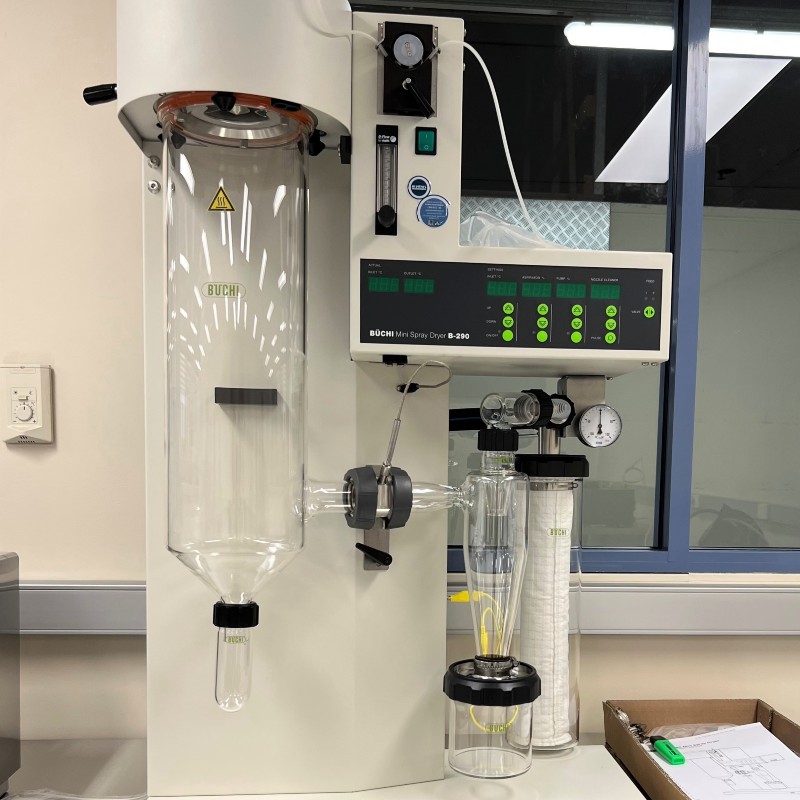
We have a range of drying equipment here at SARDI and today we’ll showcase the spray drier, the freeze dryer and dehydrator.
Drying can be used as part of sample preparation, product differentiation and shelf-life extension. Spray drying is the preferred method of drying of many temperature-sensitive liquids and is commonly used to produce milk powder, instant coffee and many powdered fruit and vegetable juices.
Liquid is pumped into the spray dryer where it forms small droplets which can quickly dry as they come into contact with hot air. The resulting powder is then captured by a cyclone.
Our spray dryer is capably of drying small volumes of liquids from 30ml up to a few litres. The final yield and quality depends on the temperature of the drying air, air flow rate, liquid flow rate and nozzle size.
Here at SARDI we have a range of nozzles to suit a variety of applications.
Freeze drying is a low temperature dehydration process that involves freezing the product, and removing the ice crystals under sublimation; under low pressure. Essentially converting ice directly into a vapour. This is in contrast to many other drying or dehydrating processes that evaporate water using heat – and as a result we can retain a higher level of nutritional value. Freeze drying also extends the shelf life, improves taste, texture and appearance, while creating a light-weight, portable food product.
Freeze dried foods are often used for hiking, camping, space exploration and emergency and survival applications and military rations.
A food dehydrator removes moisture from the food to aid in its preservation. Dehydrators work by circulating warm air over food, gradually evaporating the water.
The key to successful food dehydration is application of a constant temperature and adequate air flow.
By reducing moisture content, dehydrators prevent the growth of bacteria, mould and yeast, which are responsible for food spoilage.
Dehydrators can be used for a wide range of foods including fruits, vegetables, meats, wholemeals and beverages.
All of our equipment at SARDI has been selected based on capabilities and scalability.
For a full list of our equipment please get in touch. We look forward to collaborating with you on projects and seeing how our equipment can improve your products.